
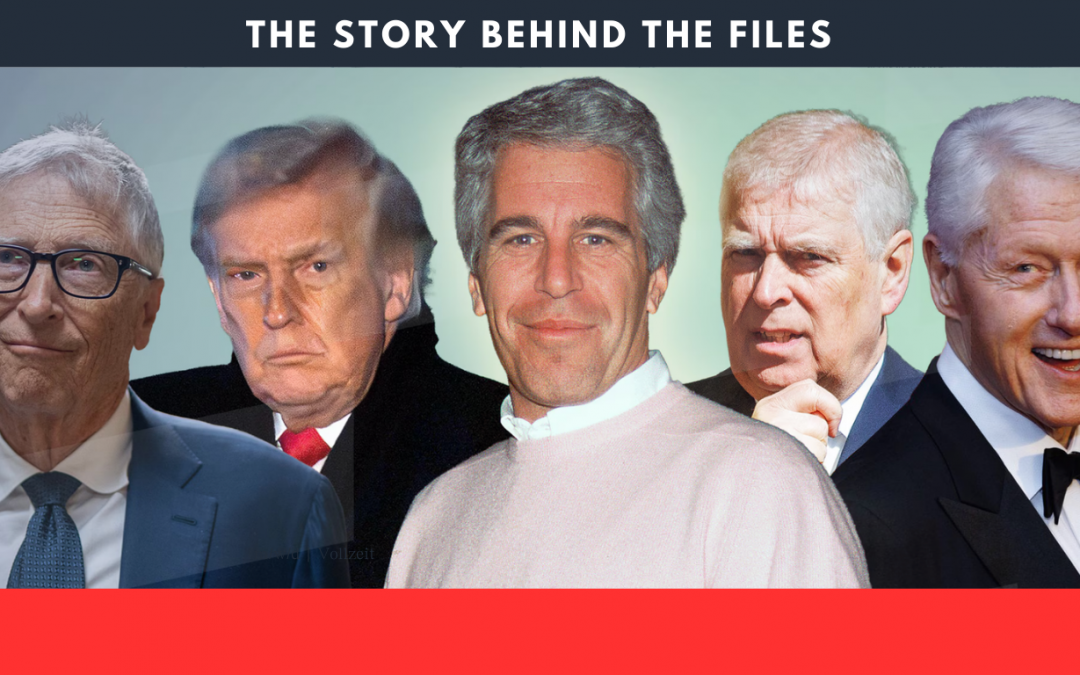
The X-Ray of an Era.
What the Epstein files reveal about AI, power, and our future.
As a woman and a mother of three children — two of them daughters — I am horrified. More than that: I am disgusted. That is the right word, and I will not soften it.
What is documented in these files are not abstract crimes. They involve underage girls who were systematically tortured and sexually abused. People who take pleasure in that — who draw a perverse energy from the suffering of children — are, in my eyes, nothing short of demonic. And I would rather be allowed to believe that I do not belong to the same species as those who do such things.
For the sake of all innocent girls and women, I wish such people lived on another planet. Far away. Forever.
But — and here is the crucial point, the reason I am writing this essay — such perversions don't just happen. No. They happen at the very heart of the global elite. The elite of politics, business, technology, monarchies. People with power, influence, responsibility. People we collectively trusted — or who, at minimum, occupy positions where trust is taken for granted.
And the horror cannot be great enough.
Because it is not enough to look away in disgust. It is not enough to morally condemn these people and then file the matter away. We must look deeper. We must understand: How was this allowed to develop? What structures enabled it? And — the most uncomfortable question of all — why might those structures still be intact?
In February 2026, the U.S. Department of Justice released 3.5 million pages of documents, over 2,000 videos, and approximately 180,000 images from the FBI's Jeffrey Epstein files. What appears at first glance to be a collection of sex crimes turns out, upon closer examination, to be something else entirely: the X-ray of a power architecture. An architecture of money, data, scientific research — and blackmail.
The Epstein files are not a scandal. A scandal comes and goes. What becomes visible here is the X-ray of a power architecture built on the concentration of power, data, and capital — and that, precisely as it becomes visible, reveals its decisive structural flaw.
And here I want to say upfront what, for me, is the only — albeit bitter — good news: The moment power structures become visible and transparent, they are exposed. Exposed power loses its force. Visibility is the end of manipulation.
There is an ancient story of King Oedipus of Thebes: When the sexual crimes of the powerful come to light, a plague descends upon the city — and only when the truth is fully laid bare can healing begin. A society without shame cannot correct itself. It represses, it silences — and rots from within.
In this essay, I will dive deep into the question: Why did such a network come into being? How did it function? And above all: Why does all of this have so much to do with artificial intelligence? But let me say this right now: Anyone who believes Epstein was only about sex crimes has not yet heard the larger half of the story. Because Epstein was — and I will show you this step by step throughout this essay — first and foremost a financial machine.
My intention is not to drag you into a dark swamp. On the contrary. I want to create order, illuminate connections — and make clear that within this crisis lies an enormous opportunity.
Because what this analysis reveals — and this comes as a genuine surprise — is that these files do not only feature tech giants like Bill Gates. Not only members of royal families, not only politicians and billionaires. But also the prestigious Harvard University. And MIT — two of the most renowned academic institutions in the world.
And here is where it gets truly interesting. Here is where it leads directly to my core subject: artificial intelligence. But before we get there, we need to understand how this network actually operated — and why the fixation on sex crimes may be the greatest smokescreen in recent criminal history.
Part 1: The Upper World — and the Collapse of an Image
Let's not kid ourselves: What is in these files is hard to read. Not because of the language, but because of the names. Deepak Chopra — a spiritual thought leader to whom millions entrusted their search for meaning — in frequent email contact with Epstein, discussing topics ranging from personal finances to discreet advice. Bill Gates, who in documented correspondence attempts to manage a blackmail situation resulting from his connection to Epstein.
Sources: List of persons named in the Epstein files — Wikipedia, February 2026; The Guardian, January 2026
And that is just the surface. In Epstein's infamous "Black Book" — his contact directory, publicly available since 2015 — we find: Donald Trump with multiple phone numbers, Bill Clinton, Prince Andrew, Ehud Barak, Tony Blair. Media moguls like Rupert Murdoch and Michael Bloomberg. Business titans like Richard Branson, David Koch, and Carl Icahn. Celebrities like Alec Baldwin, Michael Jackson, and Mick Jagger. Scientists like Marvin Minsky, Lawrence Krauss, and Steven Pinker.
Yet a critical point is often overlooked: Epstein's butler circled certain names in that book — those individuals whom, according to his testimony, were directly involved in the sex trafficking. The majority of the names are not circled. What does that mean? That most of these contacts were part of Epstein's network for an entirely different reason. What reason? I'll get to that shortly.
Sources: Mother Jones, 2015; Epstein "Little Black Book" — DocumentCloud; The Guardian, January 2026
These people do not constitute a classic criminal underworld. They represent the pillars of global institutions — the World Economic Forum, major foundations, academic establishments. The files don't reveal the underworld. They reveal the upper world.
Blackmail as a method of governance is not an accident. It is an architecture. Those who rise are observed. Compromising material is collected. At the right moment, pressure is applied — and compliance is produced.
The redacted names in the released files are perhaps the most subtle instrument of power: Every person affected knows their name is redacted. Every one of them knows that the redaction can be lifted at any time. This is not anonymization. It is leverage that continues to function.
Source: Epstein Files Transparency Act, DOJ, November 2025 — justice.gov
And precisely here — at the question of what these redactions protect and why so many uncircled names appear in that book — the trail leads directly into the financial system. Because the moment I put on my journalist's hat and started following the money instead of the headlines, the picture fundamentally shifted.
Part 2: The Financial Machine — Why It Was Never Just About Sex
The first time I read the JP Morgan correspondence and laid the Bear Stearns files alongside it, the journalist in me immediately flagged it: This is not a philanthropist. This is not an eccentric millionaire. This is someone who systematically operated at the levers of the international financial system — and whose sex crimes, as monstrous as they are, may not have been his primary activity, but rather a tool within a much larger machine.
I know: That's a provocative thesis. But it is shared by a growing number of investigative journalists and researchers, and the documented evidence is overwhelming. Let's look at it.
The Wexner Connection: A Murder, a Destroyed Report, a New Financial Advisor
Leslie Wexner — billionaire, founder of The Limited (now L Brands, parent company of Victoria's Secret) — was Epstein's most important early patron. He granted Epstein an unprecedented power of attorney over his entire fortune. Why?
The backstory is revealing: Shortly before Epstein entered the Wexner circle, Wexner's tax attorney Arthur Shapiro was shot in the face in broad daylight — one day before he was to testify before the IRS about unspecified tax havens. The police investigation report identified a link to organized crime and named Leslie Wexner in that context. That report was destroyed. The murder remains officially unsolved to this day.
And then — into that exact vacuum — Jeffrey Epstein appears and begins untangling Wexner's complicated finances.
Sources: Columbus Monthly / Columbus Dispatch, archive reports on the Shapiro murder; Whitney Webb, "One Nation Under Blackmail," 2022; The Wall Street Journal, August 2019
You don't have to be a conspiracy theorist to recognize a pattern here. You just have to read the sequence.
Bear Stearns, Insider Trading, and the Drexel Network
Epstein's Wall Street career began at Bear Stearns — and ended there under circumstances that reveal a great deal about his actual role. The SEC was investigating an insider-trading scandal involving the Bronfman family and their company Seagram's. Epstein was suspected of possessing insider knowledge about these deals. When the SEC tried to question him at Bear Stearns, he was terminated — or left "voluntarily," depending on which version you believe.
What happened next is telling: From the orbit of Drexel Burnham Lambert — the investment bank that was the epicenter of the 1980s junk bond scandal — names increasingly surfaced within Epstein's network. Chief among them: Leon Black, who had led Drexel's mergers and acquisitions division. Black handed Epstein astronomical sums for wealth management and also let him manage his family foundation. Leon Black is one of the most prominent names to emerge from the Epstein files.
Sources: The New York Times, October 2020; AP News, January 2021; Apollo Global Management investigation report, 2021
But Epstein's role in the financial system went even further — and here it becomes geopolitical. More on that in a moment. First, I need to talk about currencies.
Currency Manipulation: Letters to Heads of State
According to New York Times reporting, Epstein belonged to a network of currency traders operating at the highest levels in the 1990s. There are documented letters to heads of state in which Epstein discussed "currency stabilization" — at precisely the time when the administration in question was developing a plan to stabilize Mexico's currency. And someone from that exact trader network shorted the peso and made millions.
This is not a wealth advisor helping rich people save on taxes. This is someone profiting from currency crises — or possibly helping to cause them. The term "financial terrorist," used by investigative journalists to describe Epstein, sounds drastic. But when you look at the evidence, it is precise.
Sources: The New York Times, "How Jeffrey Epstein Made His Money," July 2019; Vicky Ward, Vanity Fair, 2003
Epstein was not a sex offender despite his financial crimes. He was both — and the sex crimes were the tool that secured the financial crimes. Compromising material on powerful people is the ultimate insurance policy.
The PROMIS Trail: Backdoors in Security Software
There is yet another connection, rarely discussed, that ties everything together — and as an AI keynote speaker, I find it particularly alarming because it shows how early the pattern of "technology as an instrument of power" was established.
On the board of Wexner's company The Limited sat a man named Alan Tesler. Tesler was the attorney for Earl Brian, one of the key players in the PROMIS software scandal of the 1980s. In that scandal, Israeli intelligence and the CIA built a backdoor into database software that was then sold to security agencies worldwide. Robert Maxwell — Ghislaine Maxwell's father — was centrally involved in distributing this compromised software.
And Epstein, who according to multiple sources collaborated with Robert Maxwell on intelligence-related financial operations, after Maxwell's death in 1991 not only took Maxwell's daughter Ghislaine into his inner circle — he effectively inherited part of the infrastructure.
Sources: Whitney Webb, "One Nation Under Blackmail," 2022; Ari Ben-Menashe, former Israeli intelligence operative, statements to The Sun and Narativ, 2019; PROMIS software scandal — multiple congressional reports from the 1990s
The Intelligence Hypothesis: Epstein as an "Access Agent"
In January 2026, former CIA officer and whistleblower John Kiriakou, speaking on the podcast The Diary of a CEO, articulated a thesis that has been discussed within the intelligence community for years but has until now been dismissed by major U.S. media as a "conspiracy theory": Jeffrey Epstein was a so-called "access agent" — a person furnished with sufficient funds by a foreign intelligence service to gain proximity to targets who themselves would be too difficult to recruit directly. Former presidents, the CEOs of the world's largest corporations, members of royal families. When asked which service was behind it, Kiriakou said: "The Israelis. I'm confident it was the Israelis."
Kiriakou also pointed to the documented surveillance cameras in Epstein's properties — including in bathrooms. Why would anyone install something like that if not to collect compromising material? Blackmail as a recruitment tool, Kiriakou explained, is a well-known practice of both Israeli and Russian intelligence.
Sources: John Kiriakou on The Diary of a CEO with Steven Bartlett, January 2026; Piers Morgan Uncensored, February 2026; Middle East Eye reporting, February 2026
Kiriakou's assessment does not stand alone. The investigative outlet Drop Site News published a multi-part series starting in the fall of 2025, based on more than 100,000 leaked emails from former Israeli Prime Minister Ehud Barak. The emails span the period from 2013 to 2016 and document what until then had only been suspected: Epstein actively brokered security agreements between Israel and other nations — including a deal with Mongolia and the sale of Israeli surveillance technology to Ivory Coast. He established a covert backchannel between Israel and Russia during the Syrian conflict. And an Israeli intelligence agent named Yoni Koren — a longtime aide to Barak with a career in covert operations — repeatedly stayed for weeks at a time in Epstein's New York apartment.
What particularly astonished Drop Site reporters Murtaza Hussain and Ryan Grim: In the emails, it was not Epstein chasing Barak — it was the other way around. A former prime minister and defense minister of Israel was dependent on Epstein's network and contacts. Hussain put it this way: The evidence suggests Epstein was not a formal Mossad agent, but functioned as an operational asset to advance Israel's most aggressive foreign policy objectives. At times, it looked as though Mossad was working for Epstein — not the other way around.
Sources: Drop Site News, "Epstein and Israel" series, September–November 2025; Democracy Now!, November 12, 2025; Common Dreams, November 13, 2025; FAIR.org, November 17, 2025
Taken together with the PROMIS scandal, Robert Maxwell's documented role in Israeli intelligence, the surveillance cameras in Epstein's homes, and the fact that Epstein after Maxwell's death took in his daughter Ghislaine and assumed parts of his operational infrastructure, a picture emerges that extends far beyond any individual case: Epstein as an operational node at the intersection of financial crime, intelligence interests, and technology control.
If all you see is the sex offender, you're looking at the finger pointing at the moon. The real question is: What state and intelligence interests did this network serve — and does it possibly still serve?
Why am I telling you all of this in such detail? Because it explains why Epstein's network was so untouchable — and why, after his arrest, there was such an obvious effort to narrow the public discussion to the sex crimes alone. It was never just about one man and his perverse inclinations. It was about a system in which financial crime, intelligence operations, and technology control interlock — and in which sex crimes served as the blackmail tool that kept the individual gears turning.
And this system — as I'll detail in Parts 4 and 5 — found its most recent arena in cryptocurrency and artificial intelligence.
Part 3: The Business Behind the Virus — Pandemic Planning as Investment Architecture
Once you understand that Epstein was first and foremost a financial architect, you will read the following chapter with different eyes. Because what concerns me most as an AI keynote speaker is not the moral failure of a few individuals. It is the documented entanglement of philanthropy, financial constructs, and pandemic preparedness — an entanglement in which the same pattern becomes visible: profit through crisis.
Beginning in 2009 — immediately after Epstein's release from prison — a documented email correspondence commenced between Epstein and senior executives at JP Morgan Chase. Epstein advised the bank on how to present "fresh ideas" to Bill Gates. He proposed so-called Donor Advised Funds (DAFs): financial instruments through which capital is immediately tax-deductible, remains under the donor's control, and can be invested tax-free on capital markets — with no deadline for charitable deployment.
Source: JP Morgan Chase Settlement, $290 million; Harvard University Report on Epstein Connections, 2020 — ogc.harvard.edu
Let that sink in: A convicted sex offender, after his release, advises one of the world's largest banks on how to sell financial products to the world's richest philanthropist. And the bank goes along with it. Why? Because Epstein's network — his access to the most powerful people in the world — was more valuable than his criminal record was deterring.
Out of these conversations emerged a fully developed investment architecture centered on pandemics and vaccines: offshore structures for vaccine development, parametric triggers — financial mechanisms that automatically generate payouts when a pandemic is declared. The World Bank adopted this concept. In April 2020, when the WHO declared COVID-19 a pandemic, those triggers were activated.
Case Study: BioNTech and Bill Gates
In September 2019, the Gates Foundation invested $55 million in BioNTech — a company that had not yet brought a single product to market. In late 2019, Gates publicly described vaccines as the "best buy" in global health. Shortly afterward, the WHO declared a pandemic, and BioNTech became the world's most recognized pharmaceutical company. By late 2021, Gates sold his stake with an estimated profit exceeding $200 million.
Sources: BioNTech Financial Report Q4 2021 — investors.biontech.de; Gates Foundation investment disclosures; Nasdaq, 2020
A few months after this sale, Gates acknowledged that the vaccine did not provide adequate transmission protection — an argument that was simultaneously being used in the German Bundestag as the primary justification for a general vaccine mandate.
I am not saying Gates planned the pandemic. I am saying: The financial architecture co-developed by a network around Epstein was constructed so that certain actors would massively profit from a pandemic. And that is exactly what happened. As a mother of three children, I watched in 2020 as an entire society was gripped by fear — while in the background, those who had invested in the right place at the right time were making billions. That has a very personal dimension for me.
The more that is prepared, the more magnates develop financial self-interest, the more likely the outbreak becomes. In their logic, pandemics increasingly resemble wars.
But anyone running financial architectures of this kind needs one thing above all: data. Data on markets, on people, on behavioral patterns. And that is exactly where the story gets even bigger.
Part 4: The Data Architecture — From DARPA to Facebook to AI
February 4, 2004
There is a date that takes on new meaning through the Epstein files: February 4, 2004. On that day, the U.S. Defense Advanced Research Projects Agency (DARPA) officially terminated its program "LifeLog." LifeLog's stated goal was to build a complete electronic database of every activity, communication, movement, and social connection of every American citizen.
Sources: DARPA LifeLog — Wikipedia; WHYY.org, "Facebook, a computing pioneer, a secret government program, and a strange coincidence"
On that same day — February 4, 2004 — Mark Zuckerberg launched "The Facebook" from his Harvard dorm room.
Was that a coincidence? There are no documented records of a formal transfer of LifeLog technology to Facebook. But the structural similarities are so striking that the journalist in me cannot simply check the box and move on: What the state could not achieve through coercion, private platforms accomplished through voluntary participation. Billions of people uploaded their photos, shared their locations, documented their relationships — and in doing so created precisely the database that LifeLog was meant to be.
The connecting link is Peter Thiel — Facebook's first outside investor with $500,000, and co-founder of Palantir, a company founded with seed capital from the CIA investment firm In-Q-Tel and explicitly designed to detect connections across massive, heterogeneous databases.
Sources: Palantir — Wikipedia; Washingtonian, "Killer App," 2012; In-Q-Tel holdings — public reports
Remember the PROMIS scandal I mentioned in Part 2? Backdoors in software sold to security agencies worldwide? That was the 1980s version of what Palantir perfected in the 2000s — only this time legal, private-sector, and incomparably more powerful.
And the Maxwell family — Ghislaine's family — played a remarkable role in this second wave as well. After Robert Maxwell's death, his daughters Isabel and Christine founded the first internet search engine, Magellan. Isabel Maxwell became a key figure in Israel's high-tech sector. Christine Maxwell, together with a senior CIA official, founded the company Chiliad, which after September 11, 2001, analyzed counterterrorism data for U.S. agencies. This is not coincidence. This is a strategy for technology dominance laid out across generations.
Sources: Whitney Webb, "One Nation Under Blackmail," 2022; The Guardian, December 2019; Haaretz, various reports on Isabel Maxwell
Cambridge Analytica — and Why We No Longer Need It
The Cambridge Analytica scandal of 2018 briefly illuminated what can be done with this data. The company used a contractual backdoor to Facebook data to build profiles of approximately 87 million users — including the data of their friends, regardless of those friends' privacy settings. The result was up to 50,000 data points per person, from which psychological profiles and individual fear triggers were distilled.
Sources: The Guardian, March 2018; Facebook–Cambridge Analytica data scandal — Wikipedia; Christopher Wylie, whistleblower testimony, TIME Magazine, 2019
Especially explosive: Palantir employees helped Cambridge Analytica process the Facebook data. Whistleblower Christopher Wylie stated that Palantir staff participated in brainstorming sessions on psychological manipulation. The circle closes: CIA seed capital, Facebook data, psychological warfare — all connected through the same networks and the same people.
We treated Cambridge Analytica as an exception. In reality, it was a blueprint — and the world kept building on it. Just more discreetly.
Today there is no need for another Cambridge Analytica scandal — because the mechanisms have long been integrated into the normal operations of the platforms. AI refines these systems — faster, more precise, more opaque. And that AI has a history that leads directly back to Jeffrey Epstein.
Part 5: Epstein as Financier of AI — and the Worldview He Propagated
The Common Sense Symposium of 2002
Jeffrey Epstein was, long before it was publicly discussed, one of the central funders of early AI research. In the spring of 2002, he invited a group of leading researchers to a Common Sense Symposium on his private island of St. Thomas. The goal: to develop the capability that machines still lacked — not pattern recognition, but human-like reasoning about everyday contexts. The results were published in 2003 in a scholarly journal that explicitly thanked Epstein for his support.
Sources: "The St. Thomas Common Sense Symposium: Designing Architectures for Human-Level Intelligence," AI Magazine, 2003 — ResearchGate; SciSpace
Among the participants were Marvin Minsky, founder of MIT's AI Lab, as well as Push Singh and other key figures in early AI research. Not marginal players — these were the people who shaped the conceptual framework of AI development. And Minsky — this must be noted because it shows the entanglement in its full scope — also surfaces in the abuse allegations against Epstein's network: Virginia Giuffre, one of the primary witnesses, stated she was "directed" to Minsky.
Source: Virginia Giuffre testimony, released as part of the Ghislaine Maxwell trial documents, 2019
A man who co-developed the foundations of artificial intelligence, and a convicted sex offender who funded that research — on the same island, at the same gatherings. When you read that as a mother — as a mother of daughters — you ask yourself: In whose hands was the development of a technology that today shapes every person's life?
Harvard, MIT, and $9.1 Million
Harvard confirmed in its own report: Epstein donated a total of $9.1 million to the university, of which $6.5 million went to found the Program for Evolutionary Dynamics (PED) under Martin Nowak in 2003. The PED was housed in a separately leased building — a spatial isolation that gave Epstein virtually unlimited access. He had his own key card, a private office ("Office 610"), and visited the lab more than 40 times between 2010 and 2018 — even though Harvard had officially decided in 2008 to accept no further funds from him.
Source: Harvard University, "Report Regarding Jeffrey Epstein's Connections to Harvard," 2020 — ogc.harvard.edu; CBS Boston, February 2026
MIT internally referred to Epstein as "Voldemort" — he who must not be named. They knew who he was. They took the money anyway: $850,000 between 2002 and 2017, of which $736,000 came after his 2008 conviction.
Crypto: The Next Frontier
And Epstein didn't stop there. In 2017, he gave an interview in which he raved about Bitcoin — not as a currency, but as a digital asset. He held documented conversations with Brock Pierce — a central figure in the early crypto scene — and Pierce himself confirmed that all of his conversations with Epstein revolved around cryptocurrency. Epstein also attempted to invest in Elizabeth Stark's company Lightning Labs — Stark declined and later went public about it.
Sources: Brock Pierce statement, various media reports, 2019; Elizabeth Stark via Twitter/X, 2019; CoinDesk, August 2019
Why would a man with Epstein's financial network be interested in cryptocurrency? The answer is self-evident: For someone who had spent decades engaged in shadow banking, currency manipulation, and offshore structures, crypto was the logical next frontier — an unregulated, pseudonymous, global financial system. The technology wasn't the goal. The ability to continue the same operations in a new medium was.
And he was not alone. Steve Bannon — another controversial figure — was actively involved during that same period in rehabilitating Epstein's image as a "science and tech investor." And this despite the fact that Epstein himself described himself at the time as "socially radioactive." Why would such people help a convicted felon rebrand? Unless they see in his network and his capabilities a value that outweighs the risk.
Sources: The Daily Beast, August 2019; The Guardian, July 2019
The SISa Model: How Algorithms "Infect" Opinions
But back to academic research — and to a discovery that directly explains why our social media feeds work the way they do. Nowak's research on social contagion — the so-called SISa model, developed together with David Rand and James Fowler — provided the mathematical foundation for algorithmic feeds: It demonstrated that in a digital system, a piece of information never fully dies out as long as external input is maintained by algorithms. This explains why certain narratives on social media display an unnatural persistence, even long after organic interest has faded.
Source: "Emotions as infectious diseases in a large social network: The SISa model" — ResearchGate; PLOS Computational Biology
The Worldview Behind It
In private conversations with leaders, Epstein compared society to a biological organism: Dead cells must be washed away. Cancer cells — elements no longer useful — must be eliminated. He rarely spoke about people. He spoke about organisms, systems, efficiency.
When I read this, I ask myself as a mother: In whose worldview would my daughters even have any value — beyond their utility?
Sources: The Guardian, August 2019; The Swaddle, "What Is Transhumanism and Why Do People Associate It With Eugenics?"
Newly released emails show that Epstein and some of the scientists he funded — including AI theorist Joscha Bach — exchanged racist and pseudoscientific ideas about intelligence and genetic hierarchies. Bach discussed in emails theories about cognitive differences between ethnic groups and the potential efficiency of fascism as a form of governance.
Sources: Mother Jones, February 2026, "Jeffrey Epstein Couldn't Stop Emailing People About Eugenics"; MS NOW; Byline Times, December 2025
This is not a historical curiosity. It is the worldview embedded in the foundations of AI research — funded by a man who treated children as a disposable resource. The question of what an AI considers "efficient," "useful," or "expendable" is not a technical question. It is a profoundly human one — and it depends on whose worldview has been fed into the training data and design decisions.
Misinformation as a System Feature
A landmark 2018 MIT study confirmed: False news on Twitter spreads 70 percent more likely than true news. It reaches 1,500 people in one-sixth the time. The maximum cascade depth for misinformation is 19 levels; for true news, 10. The primary driver is human behavior — not bots. We are the vectors.
Sources: MIT News, March 2018; MIT Initiative on the Digital Economy, "The Truth About False News"
If the system on which our public discourse takes place is mathematically optimized to spread misinformation faster than truth — then that is not a malfunction. That is a design choice.
The Epstein Network: Financial Flows and Institutional Entanglements
Documented connections between intelligence services, philanthropy, tech companies, AI research, and data infrastructure
Epstein as the documented hub — the actual puppet masters remain invisible
All data based on documented sources: DOJ Epstein Files (2026), Harvard Report (2020), MIT Investigation (2019), Drop Site News – "Epstein and Israel" series (2025), John Kiriakou / Diary of a CEO (2026), Cambridge Analytica whistleblower testimony (2018–2019), Palantir/Facebook founding history, JP Morgan Settlement (2023).
Part 6: The Facade Is Cracking — and AI as a Tool of Empowerment
I am profoundly grateful to all those who have refused to let up. Who pushed for these files to be released. Who, despite massive resistance, despite legal battles, despite threats, did not give up. And I am grateful to those who continue to do so — because anyone can see that a great deal more is going to come to light.
The facade is cracking. People around the world are waking up. And this is not naive hope — it is visible reality.
What matters is to see the connections. To refuse to accept protective claims at face value. To ensure that every individual — without immunity, without special treatment on account of rank or wealth — is held accountable. The cascading reputational collapse of those involved has already begun. Names that once seemed untouchable are now being critically scrutinized. This is only the beginning.
AI Is Not the Problem. AI Is the Tool.
I am optimistic — not naive, but strategically optimistic — that artificial intelligence can help us comb through, analyze, and understand this leviathan of 3.5 million document pages. AI can detect patterns that would escape any individual. It can make visible the connections that were concealed for decades.
But AI can do even more. When it is no longer merely a tool for the abuse of power — when it is democratized, when it is available to everyone — it can help people think more critically. It can help us conduct our own research. Verify information. Check sources. Exponentially increase our own intelligence.
Then we are no longer a herd of sheep, easily manipulated. We become serious individuals who empower themselves. Who refuse to be manipulated any longer. Who use the very same tools that were once deployed against them — only now for transparency instead of control.
What Each of Us Can Do
I want to be specific. Because good analysis that ends in helplessness is of use to no one.
First: Read the files. Not all 3.5 million pages — but the summaries that investigative journalists have compiled. Use AI tools like ChatGPT, Claude, or Perplexity to ask targeted questions of the documents. "Which financial institutions are mentioned in the Epstein files?" is a question an AI can answer in seconds — one that would take a human being weeks.
Second: Follow the money. Always. Not the headlines, not the waves of moral outrage, not the diversions. Money trails rarely lie. Court records are public. Foundation reports are accessible. Who does business with whom is documented in most democracies.
Third: Talk about it. In your networks, in your families, in your communities. Not as conspiracy theory — but on the basis of documented facts and verifiable sources. The opposite of manipulation is not silence. It is informed, evidence-based speech.
The tools are available to everyone. Use them. Uncover. Don't be intimidated. And above all: Make sure we have a democratic rule of law in which criminals — regardless of their rank and their portfolio — are convicted.
This is not utopia. This is what is happening right now. The release of the Epstein files is not an endpoint. It is a catalyst. A moment in which what could previously only be suspected becomes visible. And that visibility changes everything.
Looking Away Is Not an Option. It Is a Responsibility.
The 2026 Epstein files are more than a collection of scandals. They are the X-ray of a power architecture — and simultaneously the document of its own failure. Because these structures are now visible. And visible structures lose their power.
I write this essay as a woman, as a mother, as a former journalist — and as someone who speaks and thinks about artificial intelligence every day. From all of these perspectives, I am convinced: The greatest reorderings in history have always occurred when enough people stopped looking away — and began using the tools of their era for something better.
AI is the tool of our era. The question is not whether it exists. The question is who uses it — and for what purpose.
That decision rests with each and every one of us.
This essay is based on publicly available, documented material. All cited facts are verifiable through the sources listed above. Inclusion in Epstein's contact book or mention in this essay does not imply involvement in criminal activity.