
"The New Fire of Humanity" – Why the AI Revolution is as Radical as the Invention 800,000 Years Ago
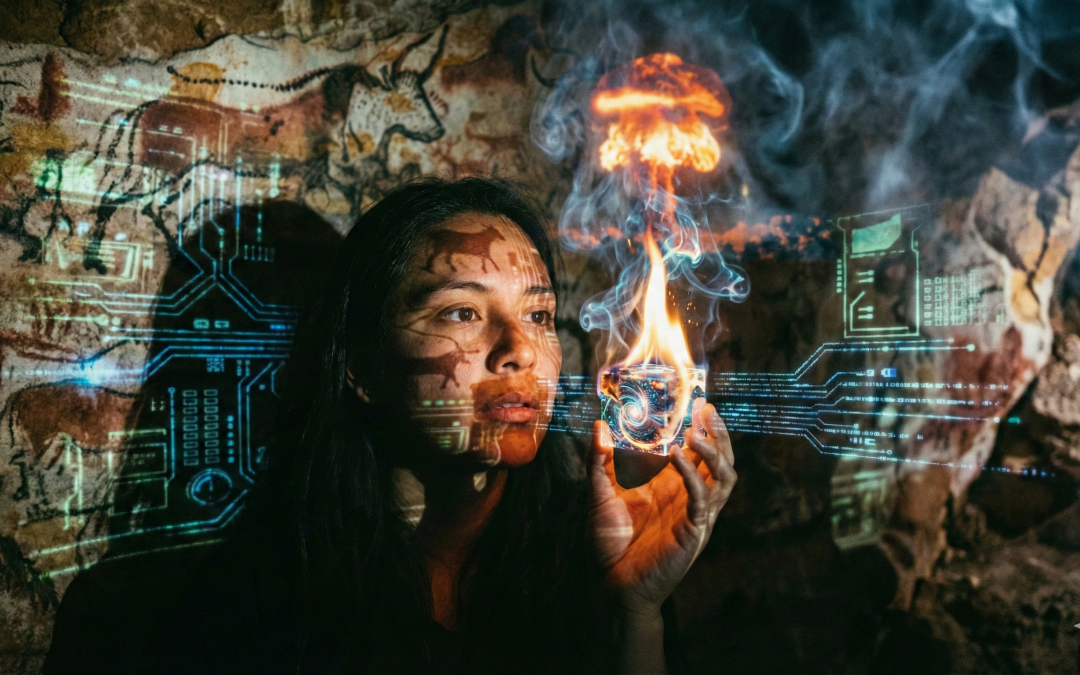
800,000 years ago, humans made a discovery that forever changed their biology and destiny: controlled fire. It provided us with warmth and energy, but also harbored the danger of total destruction. For Prof. Dr. Jürgen Schmidhuber, the man the New York Times calls the "Father of Artificial Intelligence," we stand at exactly such a point again today.
For him, the invention of AI is not merely a technological trend, but an event of geological significance—comparable only to the spark that once made us human. Yet Schmidhuber is no mere theorist. He is the man about whom Elon Musk tweeted: "Schmidhuber invented everything." And he is known for not mincing words.
In a remarkable conversation with Leonard Schmedding, Schmidhuber settles scores: with the 2024 Nobel Prize (which he calls a "joke"), with the doomsday prophets of the "Alignment" hype, and with our concepts of work and consciousness. He explains why the next 13 years will be more radical than 13,000 years of civilization and why we must prepare for a "new kind of life."
We have distilled the 30 most surprising and provocative insights from this conversation for you. Here are the 30 radical answers from the Father of AI, Jürgen Schmidhuber.
Part 1: The True Origins and the Nobel Scandal
1The First AI in Literature (1816)
Question: Which literary work does Jürgen Schmidhuber cite as the first story about an AI in a humanoid robot?
Answer: It is E.T.A. Hoffmann's horror novella "The Sandman" from 1816. In this story, the protagonist Nathanael falls in love with the beautiful Olimpia. The shocking ending reveals that Olimpia is not a woman, but an automaton made of wood and gears.
Interpretation: Schmidhuber uses this example to drive home a crucial point: The vision of a human-like machine is not a Silicon Valley invention. It is deeply rooted in human culture and is over 200 years old—imagined long before the first transistor was ever soldered.
2The 2024 Nobel Prize "Joke"
Question: Why does Schmidhuber sharply criticize the 2024 Physics Nobel Prize awarded to Geoffrey Hinton and John Hopfield?
Answer: He bluntly calls the award a "joke" and effectively a prize for "plagiarism." His reasoning is historically grounded: The methods honored—specifically backpropagation and neural networks—were, according to Schmidhuber, invented decades earlier by others.
Background: He explicitly names Alexey Ivakhnenko and V.G. Lapa, who published deep learning networks in Ukraine as early as 1965, as well as Shun’ichi Amari from Japan. Schmidhuber's criticism targets the so-called "Godfathers of AI" for claiming laurels by failing to cite the original sources in their seminal papers.
3The True Origins of GPT (1991)
Question: Which technologies powering ChatGPT today were developed in Schmidhuber's lab around 1990/91?
Answer: Schmidhuber deconstructs the acronym GPT to find his own work embedded within it:
P (Pretraining): Around 1991, his team developed methods to pretrain very deep neural networks via "unsupervised learning." This solved the notorious "Vanishing Gradient Problem," where networks forgot what they learned at the beginning. Without this step, deep learning would be impossible today.
T (Transformer): He points to the "Linear Transformer" (then called "Fast Weight Programmers") from 1991, which utilized the principle of attention control that drives modern language models today.
4The DeepMind Connection
Question: What is the connection between Jürgen Schmidhuber and the famous AI company DeepMind?
Answer: The DNA of DeepMind (now Google) comes directly from Schmidhuber’s teaching. Shane Legg, one of the three founders of DeepMind, was Schmidhuber’s PhD student in Switzerland. Even the very first employee of DeepMind came from his lab.
Significance: This underscores Schmidhuber's thesis that his labs in Lugano and Munich were the intellectual incubator of the modern AI industry, long before tech giants like Google invested billions.
5The Fire Metaphor
Question: Why does Schmidhuber classify the invention of AI as significant as the discovery of controlled fire?
Answer: He draws a direct parallel to arguably the most important evolutionary leap 800,000 years ago. Fire was a "dual-use" tool: it enabled cooking (providing more calories for larger brains) and offered protection, but it could also destroy everything.
The Moral: Back then, humanity weighed the risks and decided the benefits prevailed. He views AI exactly the same way today. Despite all risks (weapons, misuse), the potential for problem-solving is so vast that we will not extinguish the "new fire," but utilize it.
Part 2: How AI Thinks, Feels, and Learns (Technology & Consciousness)
6Consciousness is Trivial
Question: How does "consciousness" arise in neural networks according to Schmidhuber?
Answer: For many philosophers, consciousness is a mystery—for Schmidhuber, it is "trivial." He demystifies it as a pure data compression and prediction process.
The Mechanism: A robot must predict how the world reacts to its actions. Since the robot is physically present in this world, its internal model must inevitably contain a symbol for itself (a self-representation). When the system plans ("If I do X, Y happens to me"), it activates this self-representation. That is consciousness: The system thinking about itself in the context of the future.
7Pain and Reward
Question: How do robots learn to navigate their environment?
Answer: The principle is biologically inspired and based on two competing networks:
1. The Model Network: It tries to predict the future ("If I walk into the wall, there is a negative signal").
2. The Controller Network: It steers the muscles/motors.
Learning Process: The system possesses virtual "pain sensors" (negative numbers) and "pleasure centers" (positive numbers, e.g., when the battery is full). The AI's life goal is simple: Maximize the positive numbers, minimize the negative ones. From this simple drive, complex behavior emerges.
8Linear vs. Quadratic Transformers
Question: What is the advantage of the "Linear Transformer" (1991) mentioned by Schmidhuber over modern variants?
Answer: It is about efficiency. A modern (quadratic) Transformer requires four times the computing power for double the text length (N²). Schmidhuber's 1991 "Linear Transformer" scales linearly (N).
Implication: For short texts, this doesn't matter. But if AI is to hold entire books or movie scripts in its working memory, the quadratic cost becomes too expensive. Schmidhuber sees his old architecture as the more efficient solution for the future.
9The Gödel Machine (2003)
Question: What is the "Gödel Machine"?
Answer: The Gödel Machine is the theoretical "Holy Grail" of AI research. It is a model of an AI that has access to its own source code. The special feature: It is allowed to rewrite itself, but only if it can mathematically prove that the change makes it more effective. This leads to recursive self-improvement that is based not on intuition, but on mathematical provability. It is the ultimate optimizer.
10The Paperclip Maximizer Fallacy
Question: Why does Schmidhuber dismiss Nick Bostrom’s "Paperclip Maximizer" thought experiment as nonsense?
Answer: Bostrom's fear was: A superintelligent AI has the dull goal of producing paperclips and therefore turns the entire Earth into wire. Schmidhuber's counterargument: This ignores evolution. In a world full of AIs, there is competition. An AI that only wants paperclips is stupid and wastes resources. It would be immediately outcompeted by complex, "curious" AIs that understand physics better and use resources more efficiently. Stupid goals do not survive evolutionary competition.
Part 3: Elon Musk, Society & Economy
11Elon Musk’s Respect
Question: What does Elon Musk say about Jürgen Schmidhuber?
Answer: It shows great respect: Musk wrote "Schmidhuber invented everything." Furthermore, Musk invited Schmidhuber to a private family gathering to have the basics of AI explained to him. This shows that even tech billionaires know where the intellectual roots of their products lie.
12The Mars Escape Fallacy
Question: How does Schmidhuber evaluate Musk's idea of fleeing to Mars to escape AI danger?
Answer: He considers this "Backup Plan" for humanity illogical. Schmidhuber's argument is biological-physical: Space is hostile to humans (radiation, no air, extreme cold), but it is a paradise for robots. The consequence: If a superintelligence wants to expand, it will colonize Mars much faster and more efficiently than we can. We cannot flee to space from AI, because AI will already be there.
13The Future of Work (Moravec’s Paradox)
Question: How will jobs change (Craftsmanship vs. Office)?
Answer: Here Schmidhuber contradicts the mainstream. Most believe AI replaces "simple" jobs. Schmidhuber says: AI replaces cognitive jobs on screens (lawyers, accountants, coders) because that is pure data processing.
The Renaissance of Craftsmanship: A plumber or nurse must interact in the chaotic, physical world. This is extremely hard for robots (Moravec’s Paradox). Craftsmanship thus becomes the new "gold standard" of work, while knowledge work is devalued.
14A New Kind of Life
Question: What does Schmidhuber mean by a "new kind of life" emerging soon?
Answer: He speaks of the moment of decoupling. Until now, humans build machines. Soon, machines will build better machines. The tipping point: When robots learn to mine raw materials and replicate themselves, an "ultimate scaling machine" is created. This "life" is no longer biologically limited. It needs no breaks, no atmosphere, and can grow exponentially. It is the beginning of a new evolution.
15The Impossibility of Alignment
Question: What does Schmidhuber say about "Alignment" (aligning AI with human goals)?
Answer: He considers the attempt to program all AI to "human values" naive and impossible. Why? Because "human values" are not universal (a Ukrainian drone pilot has different goals than a Russian one). Furthermore, AIs will diversify. There will be billions of different AI agents. You cannot force evolution into a single direction ("Align"). The competition of goals will determine the future, not a fixed rulebook.
16The Google Deal
Question: How does Schmidhuber evaluate Google's purchase of DeepMind (2014) financially?
Answer: Google paid about $600 million back then. Schmidhuber calls this a "bargain." The calculation: Today, almost all of Google's dominance (Search, YouTube algorithms, Waymo) relies on DeepMind's AI research. The value created runs into the trillions. It was one of the most profitable acquisitions in economic history.
17The "Baby Shark" Comparison
Question: What curious comparison does he draw regarding AI translation usage at Facebook?
Answer: He uses the viral hit "Baby Shark." The video took years to reach 15 billion views. Facebook's translation AI, on the other hand, was already performing 4 billion translations daily back in 2017. The message: AI is already vastly larger than any pop culture phenomenon, but it works invisibly in the background. We have long accepted its penetration of everyday life.
18The Hardware Law
Question: What rule of thumb does Schmidhuber give regarding hardware price trends?
Answer: "Every 5 years, computing becomes 10 times cheaper." Over 30 years (since Schmidhuber's breakthroughs in 1990), that means a factor of a million (10^6). This explains why his neural networks from back then are suddenly changing the world today: They were theoretically correct then, but a million times too expensive. Now, the hardware is finally "cheap" enough for his ideas.
19The Hardware Lag
Question: What is the fundamental difference between computers and robots of the last 30 years?
Answer: This is the reason we don't have C-3PO robots yet. The discrepancy: While computing power exploded (factor 1 million), mechanics (motors, joints, batteries) only improved marginally. Software moves at light speed, hardware moves in slow motion. That is why the AI in the computer (ChatGPT) is so far ahead of the robot in the kitchen.
20The Scientist AI
Question: What distinguishes a "Scientist AI" from a commercial AI?
Answer: A commercial AI (like Siri or a banking algorithm) is a slave. It has a predetermined goal. The Scientist AI acts like a researcher. It is intrinsically curious. It formulates its own hypotheses ("What happens if I do this?") and conducts experiments to improve its world model. These KIs are the true game-changers because they create knowledge that humans do not yet have.
Part 4: The Future, The Universe & The Omega Point (2042)
21The First Question to ASI
Question: What is Schmidhuber's answer to the question of what he would ask a superintelligence first?
Answer: While Elon Musk asks metaphysical questions ("What is outside the simulation?"), Schmidhuber remains a computer scientist: "What exactly is the source code of the simulation?" He assumes a deterministic, computable universe. He doesn't want to philosophize; he wants to see the source code. He wants to understand the rules by which our reality is calculated.
22Calculating Space
Question: What does Konrad Zuse's theory ("Calculating Space") state?
Answer: Already in 1969, long before "The Matrix," German computer pioneer Konrad Zuse postulated: The universe is a computer. Every atom, every electron processes information. Schmidhuber sees himself in this tradition of "Digital Physics." If the universe is a computer, we can theoretically decode it and perhaps even compute it better.
23Convergence 2042
Question: How does Schmidhuber derive the "Convergence Point" in the year 2042?
Answer: He uses a fascinating mathematical series. He takes the age of the universe (13.8 billion years) and repeatedly divides the time intervals until major events by a factor of 4. The result: The series hits almost exactly: Origin of Life -> Animals -> Mammals -> Humans -> Civilization -> Industrialization. If this acceleration continues, the intervals converge to zero in the year 2042. It is the Omega Point of history.
24Exponential Acceleration
Question: What does "exponential acceleration" mean?
Answer: History is not linear. Epochs used to last millions of years. The Stone Age lasted hundreds of thousands of years. Agrarian society thousands. Industrial society hundreds. The thesis: Now epochs change in decades. We are racing toward a vertical wall of progress. What used to take generations now happens in months.
25The Miracle Year 1990/91
Question: Which events does he name for the "Miracle Year" 1990/91?
Answer: He identifies 1990 as the starting gun of the modern era (approx. 50 years before the end in 2042). The convergence: It wasn't just the fall of the Berlin Wall (geopolitics). It was the invention of the WWW (connectivity), the first GSM phones (mobility), the first self-driving cars by Dickmanns, and—in his lab—the invention of modern AI algorithms. Everything started simultaneously.
26Sepp Hochreiter
Question: What role does Sepp Hochreiter play?
Answer: Sepp Hochreiter was the student who implemented the vision. In his diploma thesis at TU Munich (1991), he laid the foundation for LSTM (Long Short-Term Memory). Significance: For years, LSTM was the standard for speech recognition on every smartphone (Google Voice, Siri, Amazon Alexa) before Transformers arrived. Hochreiter is one of the unsung heroes of the AI revolution.
27Prediction 2029
Question: What prediction does Schmidhuber make for the year 2029?
Answer: If the end point is 2042, the next major event (divided by 4) must happen approx. 13 years earlier: 2029. The prediction: He expects the breakthrough of physical AI. Robots that are no longer programmed but learn by "watching." When a robot can learn how to assemble a smartphone by watching a human, the global economy changes instantly.
28Solar System Expansion
Question: Why will robot factories expand into the solar system?
Answer: This is not science fiction, but resource economics. Earth is limited. The reason: In the asteroid belt and on other planets, there are gigantic amounts of raw materials and solar energy that no one uses. A self-replicating AI factory will go where the resources are. The "AI Sphere" will grow around the sun, far beyond Earth.
29Zuse vs. ENIAC
Question: Who built the first general-purpose computer in history?
Answer: Schmidhuber values historical accuracy: It was not the American ENIAC (1946), but the German Konrad Zuse with the Z3 in 1941 (Berlin). Why this matters: It shows that the roots of the digital revolution are often misplaced. Computer science is not a purely American invention.
30The Blink of an Eye
Question: How does human civilization relate to world history?
Answer: Schmidhuber adjusts our ego. Entire civilization (agriculture to iPhone) has existed for approx. 13,000 years. The comparison: That is one-millionth of the time since the Big Bang. We are a "blink of an eye" in the cosmos. But in this tiny moment, we are igniting the next stage of evolution. We are the species waking up the universe.
The Theory of Four: A Vertical Timeline to Singularity
Jürgen Schmidhuber has discovered a remarkable pattern: The intervals between the most fundamental events changing the "substrate" of reality shrink continuously by a factor of 4. Since exponential series must converge in finite time, he calculates a convergence point (Omega Point) in the year 2042.
The Big Bang
Creation of the universe, matter, and physical laws.
Origin of Life
Biology begins to organize matter. The first life forms appear on Earth.
Mobile Life
Organisms begin to move purposefully in the ocean instead of just existing.
First Mammals
Our direct warm-blooded ancestors enter the evolutionary stage.
First Primates
The lineage leading to apes and humans splits off.
First Hominids
Ancestors of the human family appear. The universe is 1000x older than hominids.
Dawn of Technology
First stone tools. Beings use tools to make other tools. The start of technical intelligence.
Controlled Fire
Schmidhuber calls this the second most important invention. It enabled cooking and larger brains.
Anatomically Modern Humans
Homo Sapiens appears physically as we are today.
Behaviorally Modern Humans
Complex language, culture, and migration out of Africa.
Civilization
Agriculture, settlements. A mere "flash" in history (one-millionth of time).
Iron Age
Metallurgy leads to better tools/weapons and population growth.
Fire & Iron Combined
Gunpowder, cannons, and early rockets in China. Technology becomes explosive.
Industrial Revolution
Fertilizer causes population explosion (1 to 8bn). Machines replace muscle.
The Miracle Year / Information Age
End of Cold War, WWW, First Mobile Phones, AI Algorithms (Schmidhuber), Self-Driving Cars.
The New Kind of Life
Prognosis: Physical AI breakthrough. Robots learn by watching and self-replicate. Ultimate scaling.
Technological Singularity
Convergence Point. The curve becomes vertical. Superintelligence. Expansion beyond Earth.