
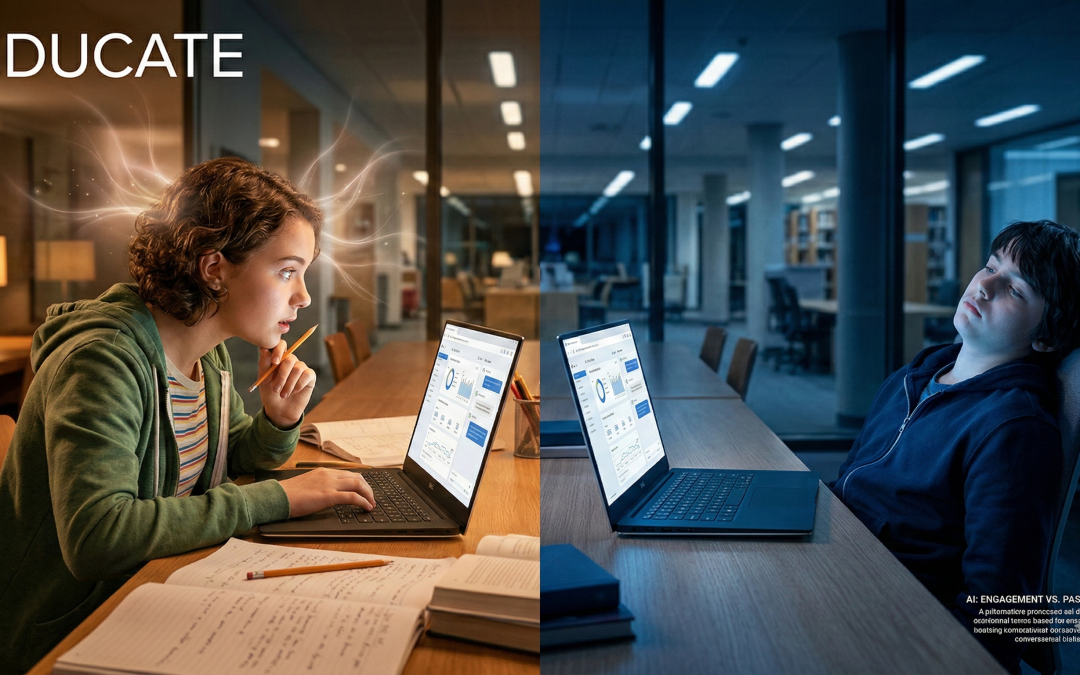
The AI Education Paradox.
The Same Technology That Creates Geniuses Is Making Us Stupid — How AI is simultaneously producing 14-year-old SAT prodigies and a generation that can't remember what it wrote five minutes ago.
March 2026
Our schools were designed in the Industrial Age to produce factory workers. And if you look closely, the operating system hasn't changed: we educate children in batches, govern their days by ringing bells, and reward them for one skill above all others — following instructions. Sit down. Open your books. Turn to page 40. Stop talking. Every minute of a child's life is tightly controlled by a system that was built for mass production, not for developing creative, autonomous human beings.
Thought leaders have been saying this for decades. As Sal Khan of Khan Academy once put it:
"Lecturing is a fundamentally dehumanizing experience. 30 kids with fingers on their lips, not allowed to interact with each other."
— Sal Khan, Khan Academy
But nothing changed — because there was no viable alternative. You can't put a personal tutor in front of every child. You can't customize the curriculum for 30 different brains in one classroom. You can't measure whether a student is actually learning or just memorizing facts they'll forget the day after the exam.
Until now. AI changes everything about that equation.
But here's a fact that should keep every parent awake at night: the same technology that helps 14-year-olds score 1500+ on the SAT is also destroying college students' ability to remember a single sentence they just wrote.
Welcome to the AI education paradox — the most uncomfortable conversation nobody wants to have.
The Genius Factory
At Alpha Schools, a radical K-12 program with campuses popping up across the United States, something almost unbelievable is happening. Freshmen — 14-year-olds — are averaging 1410 on the SAT. Their seniors hit 1535. The national average? 1024.
These kids complete their entire academic curriculum in two hours a day. Not because they're cutting corners — because AI-powered tutoring systems generate personalized lessons calibrated to each student's knowledge graph, interest profile, and cognitive load capacity. The system keeps every student in what learning scientists call the "zone of proximal development" — that sweet spot between 80 and 85 percent accuracy where learning actually happens. Not so easy you zone out. Not so hard you give up.
The rest of the day? Fifth graders run food trucks. High schoolers build Broadway musicals from scratch — sourcing talent on TikTok, negotiating music rights, handling venue sales. One student recently submitted her research to Nature. No high school student has ever been published there before.
When asked whether they'd rather go to school or go on vacation, 40 to 60 percent of students choose school.
"We've known for 40 years how kids could learn two, five, or ten times faster. Unfortunately, it doesn't work in a teacher-in-front-of-a-classroom model."
— Joe Lamont, Principal of Alpha Schools
If you think this sounds like science fiction, consider that the underlying learning science has existed for 40 years. Bloom's famous "two sigma" paper from 1984 already demonstrated that one-on-one tutoring could move every student to the top 2 percent. The problem was always scalability — you couldn't put a personal tutor in front of every child. AI solved that problem overnight.
Sources: Peter Diamandis, Moonshots Podcast, interview with Mackenzie Price & Joe Lamont, 2025; Benjamin Bloom, "The 2 Sigma Problem," Educational Researcher, 1984
The Stupidity Machine
Now here's the other side.
A recent study from MIT Media Lab put 54 university students through a writing exercise — some working on their own, some with internet search, and some using GPT-4o. The researchers monitored their brain activity with EEG the entire time.
The results were devastating. 83 percent of AI-assisted students couldn't accurately quote a single line from essays they had just written. In the other groups, it was only 11 percent. Brain activity in the AI group was roughly half as strong as in the unaided writers.
But here's the part that should truly alarm you: after three sessions, the researchers switched the AI group to writing without assistance. Their performance didn't recover. 78 percent still couldn't recall their own writing. Their brain activity still lacked the neural synchronization associated with deep cognitive engagement.
The researchers call it "cognitive debt." Your brain, it turns out, adapts quickly to not being used — and doesn't bounce back as easily.
83% of AI-assisted students could not accurately quote any text they had just written. Their brain activity was roughly half as strong as that of unaided writers.
— MIT Media Lab study, 2025
This isn't an isolated finding. A Microsoft study showed that AI-reliant users demonstrate significantly less critical thinking. Research from the University of Houston found that while AI-assisted brainstorming produces ideas rated as more creative by human judges, it also drastically reduces the variety of those ideas. The creativity is an illusion — a temporary novelty effect that will homogenize over time.
Meanwhile, university professors report that students increasingly cannot read and comprehend long texts because they've trained themselves to feed everything into ChatGPT and skim the summary. One writing teacher quit entirely because she was grading AI-generated papers more often than human ones.
Sources: MIT Media Lab EEG study, 2025; Microsoft Research, "The Impact of AI on Critical Thinking," 2024; University of Houston, "AI and Creative Ideation," 2024; Sabine Hossenfelder, "Every time I use ChatGPT I feel a little bit dumber," 2025; The Chronicle of Higher Education, 2025
Same Technology, Opposite Outcomes — Why?
So how can the same underlying technology produce genius-level 14-year-olds and intellectually declining 20-year-olds at the same time?
The answer isn't in the technology. It's in the architecture around it.
At Alpha Schools, AI doesn't do the thinking for the student. It generates the lesson — calibrated, personalized, optimally difficult — and then the student has to do the cognitive work. Vision models watch students' screens in real time, flagging when they're guessing answers, skipping explanations, or scrolling without engaging. The system literally has a "waste meter" that tells kids how much of their time they're squandering. There is no chat function during academic hours. As co-founder Joe Lamont puts it bluntly:
"If you give kids ChatGPT in a school, 90% of them use it to cheat. Chat bots are cheat bots. But if you're not using AI in the afternoon on life skill workshops, you're probably failing."
— Joe Lamont
In contrast, the typical college student's relationship with AI is the exact opposite. The AI does the thinking. The student is the passive recipient. Dump the prompt in, hand in whatever comes out. When that became too obvious, students started instructing the AI to sound dumber or adding typos by hand.
The distinction is architectural, not technological. In one model, AI raises the floor by ensuring every student gets an optimally challenging learning experience. In the other, AI lowers the ceiling by removing the need to think at all.
In one model, AI raises the floor. In the other, AI lowers the ceiling by removing the need to think at all.
The Uncomfortable Truth for Parents
Here's what makes this genuinely difficult: both models use the same technology.
If your child is using AI the way Alpha Schools designs it — as a tutor that generates challenges, monitors engagement, and refuses to give away answers — they're likely learning faster than any previous generation of humans.
If your child is using AI the way most people naturally default to — as a shortcut that eliminates cognitive effort — they're likely accumulating cognitive debt that may take years to reverse. If it reverses at all.
The research is not ambiguous on this point. The MIT study showed measurable neurological changes after just three sessions. Three. Not three years. Three sessions.
The students who used AI didn't know they were getting worse. Their subjective experience was positive. It felt easier. It felt more productive. The cognitive decline was invisible from the inside — which is exactly what makes it dangerous.
The Question Nobody Wants to Answer
The education establishment is currently locked in a binary debate: AI in schools — yes or no? Screen time — good or bad?
This is the wrong question. Spectacularly wrong.
The right question is: who controls the cognitive architecture?
When Alpha Schools deploys AI, they spend $10,000 per student per year on AI tokens alone — much of it on vision models that monitor learning behavior in real time. They employ learning scientists. They've built a closed-loop data system that measures whether each lesson actually produced learning, then adjusts. They've invested over $100 million in their platform.
When a teenager opens ChatGPT at their kitchen table, none of that exists. There's no architecture. There's no monitoring. There's no feedback loop. There's just a frictionless path to not thinking.
The technology is identical. The outcome is diametrically opposite.
Background: Alpha Schools' Five Pillars of 10x Education
What a school built from first principles looks like — and why it works
1. Kids Must Love School
Over 90% of Alpha students report loving school. 40–60% say they'd rather go to school than go on vacation. Two-thirds of high schoolers asked to skip summer break. The core principle: if kids are going to spend a decade in a system, they should want to be there.
2. Learn 10x Faster
AI tutors — not chatbots — generate personalized lessons based on each student's knowledge graph, interest profile, and cognitive load. The engine keeps accuracy between 80–85%: not too easy, not too hard. The result: full K-12 academics in two hours a day.
3. Life Skills Every Afternoon
The freed-up time goes into workshops: leadership, public speaking, entrepreneurship, financial literacy, and grit. Fifth graders run Airbnbs. High schoolers sail from Florida to the Bahamas. The curriculum teaches kids to be creators, not consumers.
4. Guides, Not Teachers
Adults in the classroom focus solely on motivational and emotional support. No lesson plans, no grading, no lectures. Guides are sourced from coaching, athletics, and executive backgrounds — and start at six-figure salaries. 80,000 people applied for these roles.
5. Character, Culture, Classmates
Socialization isn't left to chance — it's coached. Weekly one-on-one meetings with guides. Growth mindset training. A culture where the most popular item in the school store isn't a toy — it's a special lunch with their guide.
Alpha Schools has invested over $100 million in its Timeback platform. The model is private, currently priced at the high end, with plans to scale to a billion kids through alternative school models and video game–based motivation systems.
What This Means for the Future
For over a century, we've run an education system designed to produce compliant factory workers — batching children by age, drilling them through standardized curricula, measuring success by how well they memorize and regurgitate. The system never asked the most important questions: What is this child good at? What do they want to do in life? How do they learn best? It didn't need to. Factories didn't require passionate, autonomous thinkers. They required obedience.
That world is gone. And now we're standing at a fork in the road that most people don't even see.
One path leads to a generation of extraordinarily capable humans — kids who've mastered academics by age 14 and spent their remaining school years building real businesses, creating art, developing genuine expertise. Kids who've been coached on grit, leadership, and critical thinking by dedicated mentors while AI handles the mechanical transfer of knowledge. Kids who finally have what the Industrial Age system never offered: autonomy, personalization, and room for passion.
The other path leads to what researchers euphemistically call "cognitive debt" — a generation that can't read a long text, can't remember what they wrote five minutes ago, and whose neural activity during intellectual tasks is half of what it should be. A generation that feels productive while their cognitive capacity quietly atrophies. A generation that traded the passive obedience of the factory-era classroom for the passive obedience of the chatbot prompt.
Think about that for a moment. We spent a hundred years training children to follow instructions from a teacher at the front of a room. Now we risk training them to follow outputs from a language model on a screen.
The furniture changed. The passivity didn't.
Both paths are being walked right now. Both are accelerating. And the factor that determines which path your child takes is not whether they use AI. It's how the AI is designed to interact with their brain.
Alpha Schools' founder Mackenzie Price likes to say:
"This is the best time in history to be a five-year-old."
— Mackenzie Price, CEO of Alpha Schools
She might be right. But it might also be the most dangerous. The Industrial Age education system failed because it treated children as identical units on an assembly line. The AI age could fail for the opposite reason — by giving each child a perfectly personalized path to never having to think at all.
The technology doesn't care which future we build.
But our children will live with the consequences.