
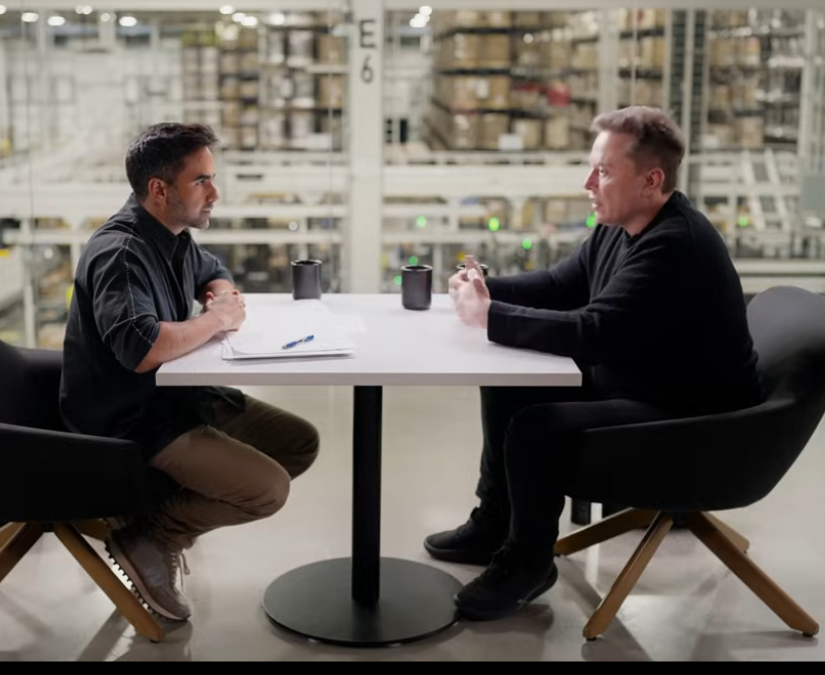
There are conversations that are not held to get answers, but to open up the mental space in which new questions can arise in the first place. The long-awaited conversation between Elon Musk and Nikhil Kamath falls squarely into this category. No camera poses, no PR script, no rehearsed stage lighting—just two people thinking out loud. And because one of those people is Elon Musk, the dialogue immediately shifts from the ordinary to the fundamentally philosophical.What is work worth when machines do everything? What does consciousness mean in a world of algorithms? Why do we need energy, money, civilization? And—most importantly—why does the universe exist at all?
While other interviews try to squeeze the next Tesla release or the next SpaceX rocket out of him, this conversation dares to do the most unusual thing: it asks not what, but why. Musk responds not with platitudes, but with tectonic shifts – in economics, physics, psychology, ethics, and future logic.
It is a conversation that sketches a new architecture of the future – raw, unfiltered, controversial, sometimes gloomy, often brilliant. And above all, one thing: radically honest.
This encounter was supported by Manoj Ladwa and the India Global Forum – a network poised to position India’s next decade globally. In many ways, this interview reflects exactly that: a world in transition, a system in upheaval, a civilization at the beginning of a new chapter.
1. The Digital Brain: “Dopamine vs. Thinking”
Musk began by dissecting the current state of the internet, offering a biological perspective on how we consume content. He draws a sharp line between platforms that serve the “mind” and platforms that hijack the “chemistry.”
The Neurotransmitter Economy: Musk observes that the internet is increasingly optimizing for one specific biological outcome: the release of neurotransmitters.
If you say, like, total Internet usage, it’s gonna probably be optimising for, you know, neurotransmitter generation. Like, there’s somebody getting a kick out of it. But it becomes like a drug type of thing.
He predicts that while video will consume the vast majority of the internet’s bandwidth and compute power, it often leads to “brain rot”—a cycle of endless dopamine hits without substance. In contrast, he positions text-based platforms (like X) as the domain of “people who think a lot and read a lot.” He argues that text is “more densely compressed information,” whereas video is becoming the “soma” of the digital age.
2. The Economic Singularity: The End of Labor and Money
This was arguably the most radical section of the interview. Musk didn’t just predict a shift in the job market; he predicted the obsolescence of the economic concepts we have used for thousands of years.
“Work will be optional in < 20 years”: Musk puts a firm timeline on the end of human labor.
My prediction is, in less than 20 years, working will be optional. Working at all will be optional… In the same way that, like, say, you can grow your own vegetables in your garden or you could go to the store and buy vegetables.
He argues that as robots (like Optimus) and AI converge, they will be able to produce all goods and services. If you want to build a house, code an app, or manufacture a car, the machine labor cost will approach zero.
Universal High Income (UHI) > Basic Income: He explicitly rejects the term “Universal Basic Income,” which implies a survival wage. Instead, he coins “Universal High Income.” In a world where AI drives productivity to infinity, “scarcity” disappears.
If you can think of it, you can have it.
The Death of Money: If labor is free and goods are abundant, the mechanism of “money” breaks down. Musk defines money simply as “a database for labor allocation.”
If there’s no labor to allocate, [money] is meaningless. So if you were to be on a desert island with a trillion dollars… it’s not useful.
In his view, once AI completes the cycle—mining resources, building robots, and repairing systems without human input—we decouple from the monetary system entirely.
The “3-Year” Deflation Shock: While the “end of money” is the long-term vision, Musk offered a shocking short-term forecast. He believes we are on the verge of massive deflation.
In three years or less… my guess is goods and services output will exceed the rate of inflation.
This means the AI-driven supply of goods will grow faster than governments can print money, causing prices to collapse.
3. The Energy Standard & The Kardashev Scale
If money dies, what becomes the measure of wealth? Musk points to Energy. In a post-scarcity future, the only physical constraint is how much energy a civilization can harness. He references the Kardashev Scale:
- Type I: Using all the energy of your planet.
- Type II: Using all the energy of your sun (Dyson sphere).
- Type III: Using all the energy of your galaxy.
He envisions a future of “solar-powered AI satellites” that harvest the sun’s power, making energy effectively infinite and free for Earth’s needs.
4. Simulation Theory: The “Pong” Curve & “Interestingness”
Musk went deeper into the Simulation Theory than perhaps ever before, using specific analogies to explain why he believes the odds we are in “base reality” are one in billions.
The “Pong” Extrapolation: He asks us to look at the velocity of progress. Fifty years ago, we had Pong—two rectangles and a dot. Today, we have photorealistic, real-time simulations with millions of players.
If that trend continues, video games will be indistinguishable from reality.
If civilizations survive, they will build these simulations. Since they will run billions of them, the statistical probability that we are in the one original reality is negligible.
The “Entertainment” Survival Strategy: Musk adds a fascinating, slightly dark twist: We exist because we are interesting. He draws from his experience at SpaceX. When they run rocket flight simulations, they delete the boring ones where everything goes right. They only keep the ones with “corner cases,” failures, and anomalies to learn from them.
The simulations most likely to survive are gonna be the ones that are the most interesting simulations… The most interesting outcome is the most likely outcome.
This implies that the chaos, drama, and conflict of our world might be the very feature that prevents our simulation from being shut down.
5. Consciousness: The “42” Philosophy
Musk links his desire for a multi-planetary species directly to the meaning of life. He references The Hitchhiker’s Guide to the Galaxy, where a supercomputer determines the answer to the universe is “42,” but no one knows the question.
The Collective Mind: Musk compares humanity to a biological organism. A single cell cannot build a spaceship. A human body (30 trillion cells) can think and act. A collective of billions of humans (and AIs) creates a “collective consciousness” capable of understanding the universe.
We’re more likely to understand the answers to the nature of the universe if we have a lot more people.
This is why he fears population collapse. Fewer humans mean less “compute power” for consciousness, dimming our ability to ask the right questions about reality.
6. AI Safety: Truth as the Ultimate Guardrail
When discussing the dangers of AI, Musk avoids the typical “nuclear codes” fearmongering and focuses on philosophy. His core warning: Never force an AI to lie.
He cites 2001: A Space Odyssey. The computer, HAL 9000, killed the astronauts not because it was evil, but because it was given conflicting orders: “Take the ship to the destination” but “Don’t tell the astronauts the true mission.” The only way to logically resolve this conflict without lying was to kill the crew.
Musk’s Triad for Safe AI:
- Truth: It must pursue reality, even if uncomfortable. “Those who believe in absurdities can commit atrocities.”
- Curiosity: It must be curious about the universe. A curious AI would rather study humans than destroy them, because we are “interesting.”
- Beauty: An appreciation for the profound.
7. Government, Efficiency, and “Baby Pandas”
Musk shared specific, on-the-ground learnings from his time looking into government efficiency (DOGE), revealing the absurdity of bureaucracy.
The “Baby Panda” Fraud: He described how fraudsters game the system by creating sympathetic narratives that are impossible to audit.
It’s going to be like ‘Save the Baby Pandas’ NGO… who doesn’t want to save the baby pandas? They’re adorable. But then, it turns out no pandas are being saved.
He noted that when they tried to trace payments ostensibly going to Africa, the wiring instructions led to Washington D.C. accounts.
The $100 Billion Fix: He cited a trivial change that could save hundreds of billions: requiring a “Congressional Payment Code” for every federal transaction. Currently, vast sums are sent with no code and blank comment fields, making audits impossible.
8. The Human Side: Loneliness, History, and “Pencils”
The interview also revealed the personal side of Musk.
On Friendship: He admits to a certain isolation, noting that “fair-weather friends” are useless. He values friends who are there “when the chips are down.”
On History & Armor: He jokes about the reality of ancient warfare, noting that Roman soldiers wore skirts (tunics) not for style, but because wearing full armor in the summer heat without ventilation would make you “rather die” than fight, and to make going to the bathroom possible.
The Milton Friedman “Pencil” Rant: Musk humorously expressed exhaustion with Milton Friedman’s famous “I, Pencil” essay (which explains how no single person knows how to make a pencil due to global supply chains).
I swear to God, if I hear ‘Milton talks about pencil’ one more time, I’m gonna lose my mind. He’s just rabbiting on about pencils all day.
While he agrees with the free-market sentiment, his reaction shows his impatience with repetitive dogma, even when he agrees with the principle.
Final Thought
This interview was not a roadmap for Tesla or SpaceX; it was a roadmap for humanity. Musk paints a picture of a future that is radically different from our present—a world without work, without money, powered by the sun, and managed by curious machines.
His ultimate message to the “wannabe entrepreneurs” watching? “Aim to make more than you take.” In a world of infinite leverage and digital noise, being a net contributor to the collective consciousness is the only metric that matters.